The Deformation - Part 1
The Early Church vs Modern Christians

We have a big problem in Christianity today. The specific doctrines that we’re teaching people about salvation were unknown until about 500 years ago.
Worse than that, if you explained exactly what people like John MacArthur, John Piper, or Charles Stanley have been teaching about salvation to the earliest Christians, they would recognize it as the very false doctrines like Gnosticism that they had been fighting so hard to keep out of the church during the first few centuries.
We typically believe that the way of salvation described by people like Martin Luther and John Calvin during the Reformation in the 1500s was a return to some kind of original view of salvation before the Roman Catholic Church took over. That's the story we tell ourselves, but that's just not true.
For the first 300 years of Christianity, every single Christian who wrote on these issues condemned the doctrines we’ve come to know as total depravity, unconditional election, pre-determinism, and the big one, once saved, always saved, which was completely unknown in Christian history until the 1500s.
I plan on going through everything you need to know about how and why this happened in great detail in this multi-part presentation. I’ll cover everything from history to atonement theory over the course of a year, Lord willing. But in this first part, I want to explain what the early church did believe about salvation so that we can compare it with what we believe today.
Let me start off by defining what I mean when I say the early church. I’m talking about a specific group of Christians who lived just after the Book of Revelation was written, about 90 AD to around 400 AD. So, call it the first 300 years of Christianity.
This was a time of great persecution of the church by Rome and others. In fact, almost all the men we'll discuss today were burned alive, or fed to lions, or worse for their faith.
They also lived in a time before Constantine became the Emperor of Rome and made Christianity the state religion in the early 4th century, which was the event that accelerated the radical doctrinal transition to what we would call Roman Catholicism today.
These early Christian writers are sometimes called the Apostolic Fathers because many of them were taught by the apostles themselves.
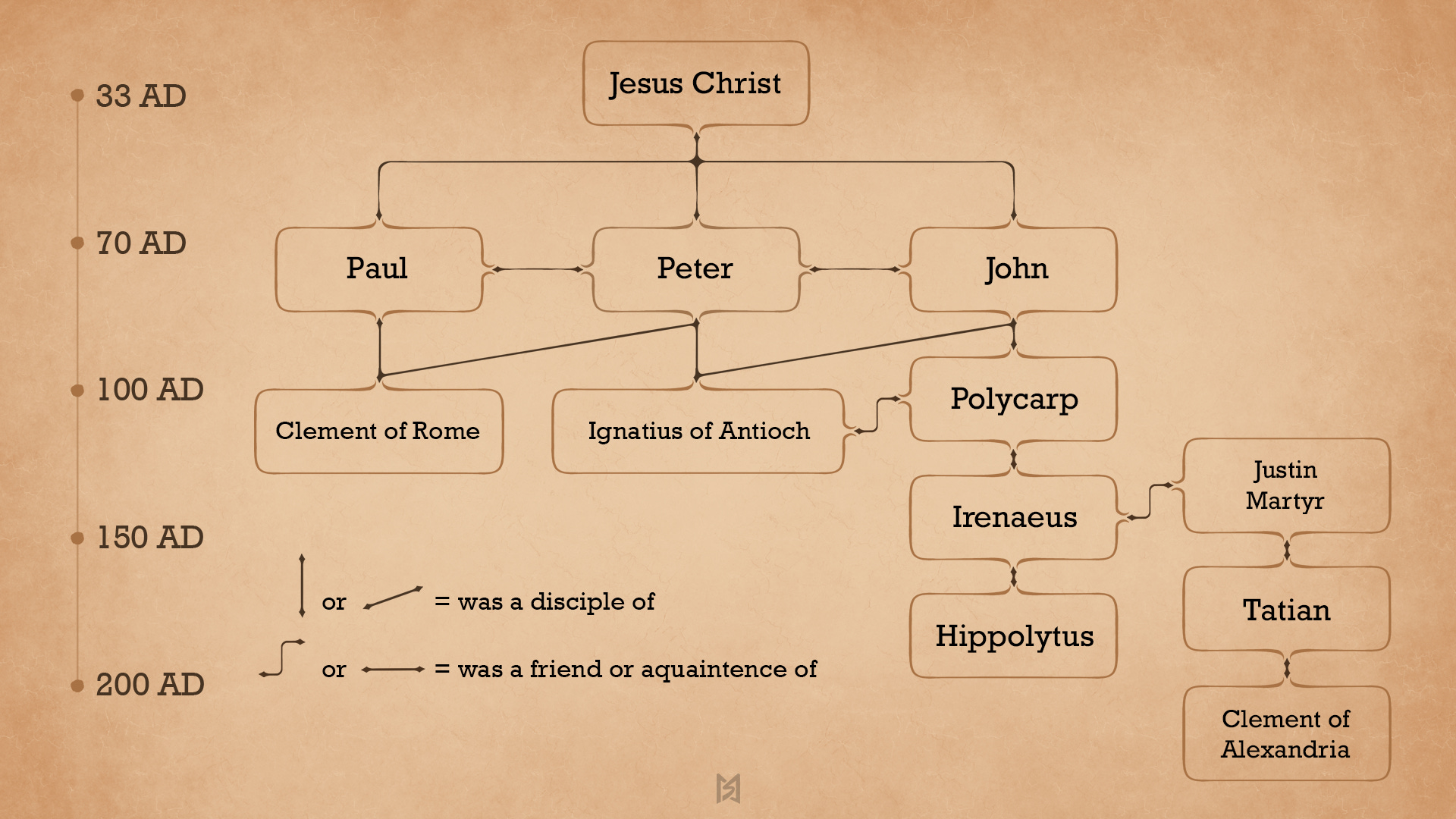
For example, Clement of Rome, mentioned by Paul in Philippians 4:3, was closely associated with Peter and Paul, the apostles. Other examples are Ignatius of Antioch and Polycarp of Smyrna, who were both direct disciples of John the Apostle, as well as Irenaeus of Lyons, who was a disciple of Polycarp, so he was connected by two degrees back to John the Apostle.
This is significant, because it means that these men could ask the apostles clarifying questions about doctrines.
They’re also sometimes referred to as the Greek Fathers because their native language was very often Koine Greek, which was the language that the New Testament was written in.
This is significant because it means that they had no language barrier to understanding the New Testament.
Another important point is that they were in lockstep agreement about the basics of salvation.
Unlike today, there didn't seem to be much, if any, divisions among them on the subject of how one was to go to heaven and avoid hell. Their writings are not infallible, of course, but they are a window into how the Gospel was first received and practiced, and they are very valuable for that purpose.
The Two Stages of Salvation
So what did the early church believe about salvation? They believed in what we might think of as a two-stage salvation.
The first stage was initial salvation, when one first becomes a Christian, which they taught was by grace through faith. They were very clear that you could not become a Christian by human effort, that it was a free gift not earned by good deeds or religious works. They believed that at the moment of your initial salvation, all your past sins are washed away, completely forgiven, and that you start with a clean slate.
The second stage of salvation, which the early Christians emphasized just as strongly, might be thought of as maintaining salvation through the power of the Spirit. They taught that believers must hold fast to their faith by living in obedience to Christ's commandments in the New Testament.
They were not believers in sinless perfection though. In fact, they specifically rejected the idea of sinless perfection. They would point out, like John did, that if anyone sins after becoming a Christian, they have an advocate with the Father, Jesus Christ. And that if they confess their sins, God will forgive them.
But they would also point out the rest of that passage in First John, which says,
“By this, we know that we have come to know Him, if we keep His commandments. The one who says I have come to know Him and does not keep His commandments is a liar, and the truth is not in him.” Or, “Little children make sure no one deceives you. The one who practices righteousness is righteous, just as He is righteous. The one who practices sin is of the devil, for the devil has been sinning from the beginning.” -1 John 2:3-6
They believed that a Christian can and must conquer the sins of the flesh that Christ and the apostles repeatedly warned believers about, that they must put them to death by the power of the Spirit, and that if they died in a backslidden state, they would go to hell.
For example, the Apostolic Constitution says,
“How do you know, O man, when you sin, whether you will live a sufficient number of days in this present state in order that you will have time to repent? For the time of your repentance [departure] out of this world is uncertain. And if you die in sin, there will remain no repentance for you…He who sins after baptism—unless he repents and forsakes his sins—will be condemned to Gehenna” - Apostolic Constitutions 2.1.13 and 2.3.7
Equally important was their teaching that believers could fall away if they abandoned their faith or refused to live in obedience to Jesus' teachings.
They quoted passages which taught that salt can lose its savor (Matthew 5:13), that branches in Christ can be cut off (John 15:2, 6), that seeds of faith can begin to grow but be choked (Matthew 13:20–22), that people who perform miracles in His name can be rejected (Matthew 7:21–23), that the bride’s lamp can be extinguished (Matthew 25:8–12), that the Holy Spirit can be quenched (1 Thessalonians 5:19), that if backsliders don’t repent and do the deeds they did at first, they will go to hell (Revelation 2:4–5), that names can be erased from the book of life (Revelation 3:5), that you can receive the grace of God in vain (2 Corinthians 6:1), that lukewarm Christians will be spewed out of His mouth (Revelation 3:16), and that in the last days, many will fall away (1 Timothy 4:1; 2 Thessalonians 2:3), and many more passages like this.
Cyprian said,
“It is a small thing to have first received something. It is a greater thing to be able to keep what you have attained. Faith itself and the saving birth do not make alive by merely being received. Rather, they must be preserved.” —Cyprian, To His Son Quirinus, Epistle (Treatise) XXVII.2
Tertullian said,
“No one is a Christian but he who perseveres even to the end.” -Prescription Against Heretics
Living as the Early Christians Did
Another interesting thing is how they lived as a result of their beliefs. David Bercot, a historian of the early church, said,
“The first Christians lived under a completely different set of principles and values than the rest of mankind, rejecting the world’s entertainment, honors, and riches because they recognized themselves as citizens of another kingdom, answering to a different master.” -- Bercot, David. Will the Real Heretics Please Stand Up . Scroll Publishing Co
They read the New Testament as if Jesus and the apostles meant every word that they said. And the logical conclusion of reading the New Testament that way is that it made them follow Jesus as if He was their actual master, living pure lives, rejecting worldly pleasures through the power of the Spirit.
Most of the sins that we accept today as normal for Christians to do occasionally—things like getting drunk, pornography, remarriage, severe anger, and unforgiveness—they would absolutely reject the idea that a Christian could regularly do those things and still go to heaven.
They would point out that the New Testament says that those who do such things will not inherit the kingdom of God (1 Corinthians 6:9–10; Galatians 5:19–21; Ephesians 5:5). They would point to Paul who said that you shouldn't even eat with a person who claims to be a Christian who is doing these things (1 Corinthians 5:11).
Their separated and holy lifestyle was the talk of the ancient world. It was in itself an evangelistic tool. People were drawn to these odd people who forgave their enemies, and rejected anger and sin, and seemed to have an otherworldly love for other people.
It was also their belief that Jesus meant everything He said that led them to readily accept death and torture for their faith. After all, Jesus on multiple occasions and in various ways said that His disciples must not deny Him during persecution, or He would deny them on judgment day. And so, when the Roman authorities gave these men the option to deny Jesus and be set free, or refuse to deny Him and be executed, they chose execution. This shocked the Roman world, as few, if any, Romans would die for their gods, and it ended up being a huge evangelism tool, and many came to faith because of their deaths.
What Changed?
So what changed? As we’ll explore in depth in later sections, the radical change from the early church to what we believe today was in large part because Martin Luther, during the Reformation, introduced the idea that Jesus wasn't actually teaching Christianity in the Sermon on the Mount.
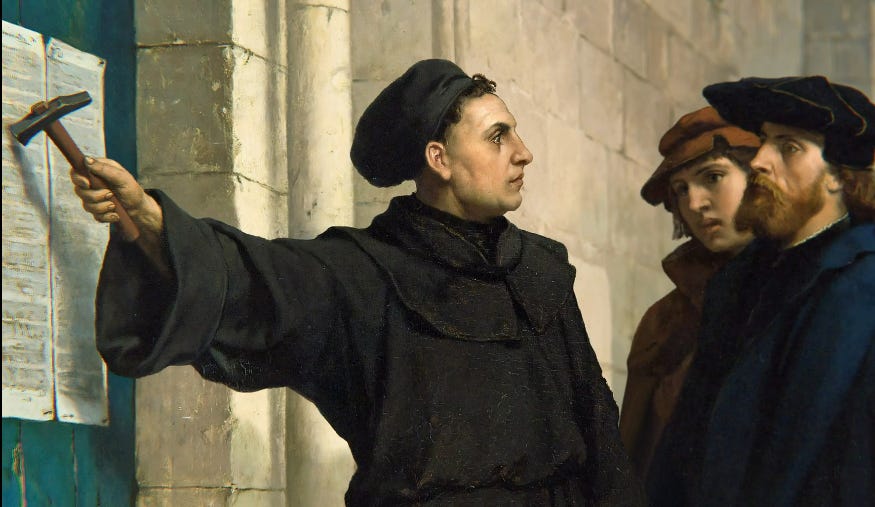
Luther said that Jesus was just teaching the Old Testament law in much of the Gospels. And according to Luther, Jesus did that so that we would know that we couldn't keep the law perfectly.
And in fact, that if we tried to do what Jesus said too much, or thought that we needed to do what Jesus said in order to go to heaven, then that was the real sin!
Luther also redefined the word “works” or the phrase “works of the law,” especially in Romans and Galatians, to mean repentance from sin, instead of just works of the Mosaic Law like circumcision.
And he used this blatant mistranslation to say that trying to defeat sin after salvation was a work, and he reintroduced the pagan idea to the church that man has absolutely no free will, and therefore, man can't help but consistently sin, even after he is saved.
In other words, the Reformation developed a doctrine that said essentially, “Ye shall not surely die if you eat of the fruit.”
In the next section, I will show how these and other Reformation doctrines came to be, and how their roots are almost entirely derived from pagan religions such as Gnosticism and Neoplatonism, and how one man in the fifth century, who was a former member of these pagan religions, brought them into the church for the first time and sowed the seeds of the doctrines that would later be taught by the Reformers.
Love your work, Dr White. Your books on Mystery Babylon and the anti-Christ have been most edifying and instructive. It's interesting to me that Augustine also did the most to suppress the Enochian and apocryphal literature which, while not holy writ, were believed by most Christians in the Ante-Nicene Period to be accurate prehistoric accounts. It marked the turn away from the mystical toward the philosophical in the church, in my view. Thank you for your excellent scholarship.
Your quoting of Martin Luther’s ideology "... if we tried to do what Jesus said too much, or thought that we needed to do what Jesus said in order to go to heaven, then that was the real sin!" aligns with the rising opposition to "Lordship Salvation", where declaring Him as Lord is an afront to true Christianity.
This looks to be an interesting read as so many today realize the need to see Scripture through the eyes of it's audience, second temple Judaism when regarding The New Covenant, as well as the TaNaKH through the mindset of those that populated the Ancient Near East.
Thank you for your work Chris