The Deformation – Part 2
Augustine, Gnosticism and Original Sin

The Rise of Augustinian Calvinism
As I described in the previous section, for the first three centuries of church history, Christians were in near-unanimous agreement about the basics of how salvation worked.
But in the early 400s, something significantly changed, which was largely the result of the teachings of one man, Augustine of Hippo. He is, without question, the most influential human figure in Christianity, other than the apostles themselves.
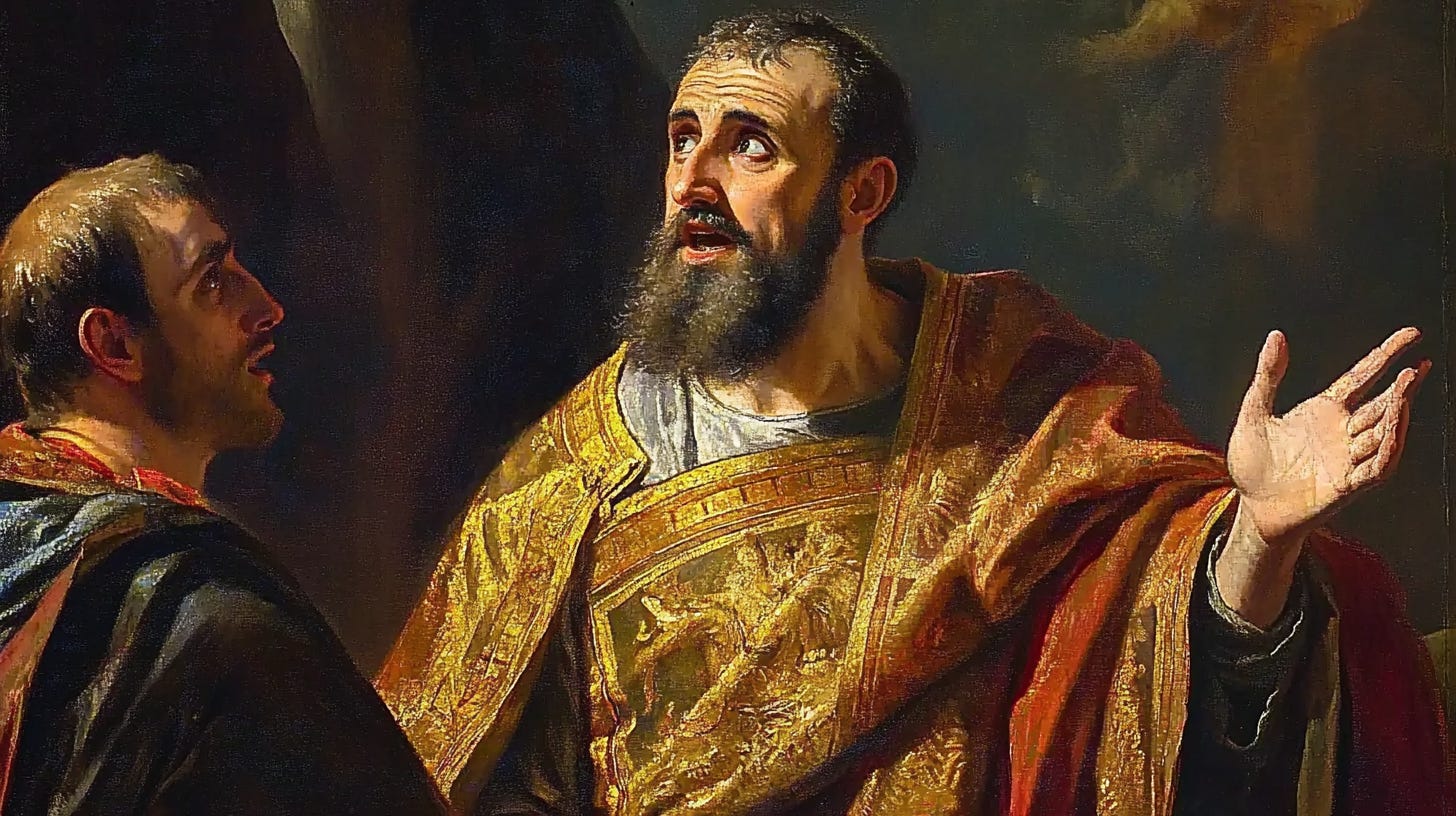
As far as Roman Catholicism goes, he invented or strongly gave his authority to doctrines like Mary being sinless, infant baptism, the idea that sex, even within marriage, is sinful, that wars can be holy, as with the Crusades, that there is no literal millennium, that miracles aren't for today, and that Christians can and should torture and kill heretics.
But ironically, he is also the father of the Protestant Reformation. For example, he invented most of the Calvinist doctrines remembered by the acrostic TULIP, as well as the idea that man has absolutely no free will to accept the gift of salvation, ideas upon which the Reformation, not just Calvinism, would be founded.
I will argue here that the doctrines we associate with the Reformation, like TULIP, were taught in the Pagan world first, especially in the two religions that Augustine was a member of before becoming a Christian, namely Gnosticism and Neoplatonism. I will also contend that those doctrines had never been taught by a single Christian before Augustine in the 400s. And in fact, that the earliest Christians passionately rejected those specific doctrines as heresy.
I'll talk about the big event in Augustine's life that caused him to bring these Pagan ideas into the Church. And finally, I’ll refute the common biblical proof texts used by Augustine, as well as modern Calvinists, to support these beliefs.
Free Will vs. Determinism
Determinism is the belief that all events, including human choices, are pre-ordained by divine will or cosmic plan. One of the most deterministic cultures was the ancient Greeks, who believed that all destiny was pre-ordained by the gods and what they called The Fates (the Moirai). But by the time of Augustine in the late fourth century, three of the most popular religious philosophies within the Greek world—Stoicism, Neoplatonism, and Gnosticism—had taken this determinism to never-before-seen levels.
The Stoics believed that every event, no matter how small, was governed by fate.
Neoplatonists asserted that divine forces predetermined all human actions, rendering free will an illusion.
Gnostics rejected the concept of free will as an illusion, and also held that humans were born inherently evil.
Augustine spent many years personally involved in these three extremely anti–free will philosophies before becoming a Christian. In fact, he was a member of the Manichean Gnostics for 10 years.
The Jews and early Christians, on the other hand, were completely opposed to the idea that fate determined men's eternal destinies. The early Christians passionately argued against groups like the Gnostics in their writings for this very reason.
Ken Wilson, in his book The Foundations of Augustinian Calvinism, says:
“Of the 84 pre-Augustinian authors studied from 95 to 430 CE, over 50 addressed this topic. All of these early Christian authors championed traditional free choice and relational predestination against Pagan and heretical divine unilateral predetermination of individuals' eternal destinies.”
Even Calvinist historian Lyman Beecher admitted:
“The free will and natural ability of men were held by the whole Church.”1
Early Christian Witnesses
Clement of Rome (1st century):
“Free will was given because he who is good by his own choice is really good, but he who has been made good by another under necessity is not really good, because he is not what he is by his own choice. For no other reason does God punish the sinner either in the present or in the future world, except because He knows that the sinner was able to conquer but neglected to gain the victory.”
(Recognitions (Book III, Chapter 23) 180–190 AD)
Tertullian (c. 200 AD):
“No reward can be justly bestowed, no punishment can be justly inflicted upon him who is good or bad by necessity, and not by his own choice. You will find that when He sets before man good and evil, life and death, that the entire course of discipline is arranged in precepts by God's calling them from sin, and threatening and exhorting them. And this on no other grounds than that man is free with a will, either for obedience or resistance.”
(Against Marcion (Book II, Chapter 5) 207–208 AD)
Total Depravity: A Pagan Idea
There was another doctrine of the Gnostics related to determinism and free will which is incredibly important for understanding what happened next, which is the belief that the created world and physical matter were totally evil and corrupted, including their own human flesh. And as a result, all of the actions of humans were inherently sinful.
This belief led the Gnostics to claim that Jesus could not have been incarnated in the flesh because that would have meant that He would be sinful, since in their view, the flesh was totally corrupted. So they taught that Jesus didn't really come in the flesh, but was a spirit being pretending to have flesh.
John the Apostle calls the Gnostics Antichrists in 2 John 1:7:
“For many deceivers have gone out into the world, those who do not acknowledge Jesus Christ as coming in the flesh. This is the deceiver and the Antichrist.”
Some early church writers pointed out that the belief that man had no free will and that his flesh was so corrupted that he could not do good was a dangerous snare. They argued that this doctrine lured people in because it gave them a license to sin. After all, that is the logical conclusion of not having the ability to do good, namely you can't reasonably be blamed for your sin if you could not help but do otherwise.
It's telling that in the context of 2 John 1, where John was calling the Gnostics Antichrists, the broader context is saying that their belief about the total corruption of the flesh was causing people not to walk in the commandments of Christ:
"And this is love, that we walk according to His commandments. This is the commandment, just as you have heard from the beginning, that you should walk in it. For many deceivers have gone out into the world, those who do not acknowledge Jesus Christ as coming in the flesh. This is the deceiver and the antichrist." — 2 John 1:6–7
The church father, Origen, speaking of the Gnostic doctrines which would later be called Total Depravity and Perseverance of the Saints, wrote,
“They essentially destroy free will by introducing ruined natures incapable of salvation and by introducing others as being saved in such a way that they cannot be lost.” - On First Principles (Book III, Chapter 2). 225–230 AD
These doctrines that the early church rejected are essentially the same beliefs found in TULIP, which are the fundamental doctrines of Calvinism and the Reformation.
And it should be noted that the founder of Calvinism, John Calvin himself, was fully aware that the early church fathers considered his teachings to be heresy. In his book, The Institutes of the Christian Religion, Calvin tells his readers that they can't trust the early church:
“It may perhaps seem that I have greatly prejudiced my own view by confessing that all ancient theologians, with the exception of Augustine, were so confused, vacillating, and contradictory on this subject that no certainty can be obtained from their writings.”
Calvin knew that he couldn't appeal to any Christians before Augustine in the fifth century to support his views because Augustine was the first person to teach TULIP. Ken Wilson says of this:
“Augustine was the father of TULIP. Not even one prior Christian author taught this theology.”2
And it’s no secret that John Calvin was influenced by Augustine. Calvin quoted Augustine over 400 times in The Institutes. And he says of Augustine,
“Augustine is so holy within me that I could write my entire theology out of his writings.”3)
The single most important part of TULIP is the T, which stands for Total Depravity.
This is the belief that every aspect of human nature is corrupted, rendering us spiritually unable to come to God on our own.
We don't even have the free will to choose His way of salvation. All of the rest of TULIP exists because of Total Depravity. I like to think of the rest of TULIP as damage control made necessary because of the fallout caused by accepting Total Depravity.
R.C. Sproul, a Calvinist, said the following:
“One cannot embrace the T and reject any of the other four letters with any degree of consistency.”4
In other words, if you believe that man is so corrupt that he cannot respond to God's call for faith, then you must also believe in the concept of irresistible grace, the I. After all, if we cannot choose God on our own because we have no free will to do so, then God must unilaterally choose us to be saved, which would logically be something that we could not resist.
Next, because we are unable to decide to follow Him on our own, Unconditional Election, the U, must be true, meaning that God chooses who will be saved based entirely on His own will, rather than on any decision to believe Him on our part.
From there, Limited Atonement follows. If God has already chosen who will be saved based on His own unknowable reasons, then Jesus' sacrifice on the cross was only meant for those people, not for everyone.
And finally, perseverance of the saints or once saved, always saved follows. Although Augustine didn't believe in once saved, always saved, but once saved, always saved does logically follow from these other premises as John Calvin and others would explain later. Because if God elects people to heaven or hell not based on anything they did or will do, and there is nothing that they could do to resist that call to heaven, then there’s also nothing that they could do to stop from persevering to salvation since it was never something they had control of in the first place.
The Doctrine of Original Sin
So now that we know how important total depravity is, we need to discuss how Augustine justified bringing into the church this pagan idea.
As I've mentioned, Augustine was a believer in the extremely deterministic pagan religions like Stoicism, Neoplatonism, and Manichean Gnosticism before becoming a Christian. He became a Christian in 386, and despite there being a strict rule at the time that former Gnostics could not become bishops, they made an exception in Augustine's case because Augustine was so good at debating with the Gnostics.
The other bishops reasoned that someone so opposed to the Gnostics would surely not go back to teaching Gnosticism. And indeed, for 25 years after Augustine's conversion to Christianity, he passionately argued against the Gnostic doctrines like determinism and total depravity, just like the rest of the church.
But all that would change around the year 412 when Augustine and a British monk named Pelagius had a public theological disagreement.
Pelagius rebuked Augustine for a statement in his writings that sounded a bit like Gnostic doctrine. The line was something like, “Give what you command and command what you will.”
Pelagius said that this made it sound like Augustine was saying that it would be God's fault if Christians did not obey His commands, as if man had no choice in the matter of obedience. Pelagius also disagreed with infant baptism, which Augustine very much supported, but more on that later.
These questions and others led to a debate between these two essentially about total depravity. Was man totally evil with no free will to choose God like the Gnostics taught? Or did man have free will?
This is also the moment where most agree that Augustine turned from the historic position of the church and began to find ways to Christianize his previous Gnostic beliefs.
To make his case for total depravity in the Bible, Augustine developed his most well-known doctrine, the doctrine of original sin. Before Augustine, Christians taught that the curse in the Garden of Eden was about death, both spiritual and physical.
They believed that we became mortal as one of the consequences of the fall, and that this weakened condition, in combination with Satan's temptations, make sin inevitable, which would lead to spiritual death and condemnation to hell.
But the early church also believed that man had the free will to choose God's free gift of salvation so as not to be condemned.
Ken Wilson says of this:
“Not even one Early Church Father writing from 95 to 430 CE, despite abundant knowledge of inherited human depravity from the Gnostics, considered Adam’s fall to have erased human free choice to independently respond to God’s gracious invitation.”5
Augustine used Romans 5:12 to make his most important case, that we are guilty and totally depraved from birth, not because of our sin, but because of Adam’s sin.
But to do this, he used the Latin Vulgate version of Romans 5:12, which was the only translation that he could read at the time since he didn't speak Greek.
The problem is that it is now universally agreed that the Latin Vulgate has a critical mistranslation of the Greek in this particular verse.
For example, look at the NASB translation of this verse, which is considered to be a fairly accurate translation of the Greek. It says,
“Therefore, just as through one man, sin entered the world, and death through sin, and so death spread to all men because all sinned.” - Romans 5:12 NASB
The Latin Vulgate is very similar, except for the last line, which says,
Wherefore as by one man sin entered into this world and by sin death: and so death passed upon all men, in whom all have sinned.” - Romans 5:12 Latin Vulgate
See the difference? In the NASB, “Death spread to all men because all sinned,” which is what the early church believed, that sin leads to death, and if you sin, you will die. But the Latin Vulgate says that, “Death spread to all men because in Adam all have sinned, meaning that humanity was in some way inside Adam, in his loins perhaps, when he sinned. And so we are condemned to death before we were even born. We were born guilty of Adam's sin.
Augustine would later develop this doctrine to mean essentially what Calvinists and most modern Christians believe today, that the curse in Genesis 3 and the Garden of Eden story was that all people are born guilty and given totally depraved natures.
However, if you turn to Genesis 3, you'll find that the curse was what God said it would be before they even ate the fruit, that they would surely die.
The ground was also cursed, the serpent was cursed, and the woman's pains in childbirth were increased. But there's not even a hint about them being given sin natures, let alone anything about everyone now being guilty of Adam's sin.
I will come back to arguments against this view from Scripture in a moment.
Infant Baptism and God's Will
But first, we need to talk about infant baptism, because it does play a significant role in this story.
Because this idea of being born guilty was mostly used by Augustine to win an argument with Pelagius about infant baptism.
Up to that point, most Christians had argued that infants and small children should not be baptized until they decide to become Christians with their own free will.
Tertullian, for example, writing around the year 200, believed that children should wait for baptism until they were old enough to personally believe in Christ.
"It may be better to delay Baptism; and especially so in the case of little children. Why, indeed, is it necessary... that the sponsors too be thrust into danger, when they themselves may fail to fulfill their promises by reason of death, or when they may be disappointed by the growth of an evil disposition?" 6
However, by Augustine's time in the fifth century, infant baptism was occasionally practiced. And Pelagius asked the question, Why are some people baptizing infants since these children cannot make a free will decision to be Christians yet?
To understand Augustine's reaction to this, you need to understand that his fundamental belief was that the act of baptism is what saves a person.
Augustine believed that when a person had holy water put on them, their sins were forgiven and they received the Holy Spirit at that moment. In Augustine's mind, water baptism itself was what saved a person.
When you combine that belief with Augustine's new belief that everyone is guilty of Adam's sin from birth, it logically follows that all infants would go to hell if they died before being baptized because the infant was guilty of Adam's sin. Augustine was therefore a huge proponent of infant baptism.
However, that teaching caused another problem, because some infants die before they can be baptized, and an infant can't control whether they are baptized or not. Therefore, Augustine concluded that God must unilaterally and unconditionally predetermine which infants are not baptized and which are baptized before dying. That was essentially the only way to get out of the corner he had painted himself into during that debate.
Refuting Proof Texts for Total Depravity
You may be thinking that there are other biblical texts besides Romans 5:12 that are put forward to argue for total depravity. And that's true, and we will look at some of those in a moment. But there are remarkably few. Augustine himself almost exclusively used the mistranslation of Romans 5:12 from the Vulgate.
The Augustinian scholar Gerald Bonner wrote about this:
“It has been remarked that the number of texts to which Augustine appealed to establish this doctrine of original sin is remarkably limited.”7
However, another very popular proof text for this is Psalm 51:5, which says,
“Behold, I was brought forth in iniquity, and in sin my mother conceived me.”
They will say that if David in this psalm was conceived in sin, then it proves that he was a sinner from birth.
Psalm 51 is a psalm about David's repentance, when Nathan the prophet called him out for the murder of Uriah and adultery with Bathsheba.
And it's about David's anguish over his sin and about the sickly child that was born out of that sin that would later die.
Notably, in this particular verse, David is not even talking about his own sin. He is talking about his mother's sin. “In sin my mother conceived me,” possibly drawing a parallel to his current situation since he also had just conceived a child through the sin of adultery.
This is made even more intriguing when you realize that the word that David is using for “conceived” here is not the normal Hebrew word for conception. In fact, this word is mostly used for animals conceiving in heat. In fact, this is the only occasion where the word is used of human sex. So this really is a graphic sin that David is saying that his mother was involved in during his conception.
There has long been speculation about the circumstances of David's birth in Jewish rabbinic tradition. And if David was born as a result of some sexual misconduct involving his mother, it would also make good sense of the story in 1 Samuel 16 where David's father, Jesse, presented all of his other sons to Samuel the prophet to be anointed as king.
Jesse didn't even seem to consider David one of his sons, and it took Samuel specifically asking Jesse if he had any other sons for Jesse to admit that David even existed.
Also, in Psalm 69, David said that he was considered a “stranger and alien” to his brothers.
I have become estranged from my brothers And an alien to my mother’s sons. - Psalm 69:8
Another common proof text for total depravity is Ephesians 2:1, which says,
“And you were dead in your trespasses and sins.”
The Calvinist argument is all about the word “dead” here.
They often say things like, “Dead means dead.” By that they mean that a dead man has no ability to choose salvation because they were dead. Therefore, they are unable to respond to God’s call to salvation.
Leighton Flowers states:
“Calvinists insist without much biblical foundation that the term ‘dead’ connotes an innate moral inability inherently passed down to every human being as a result of the fall of Adam.”8
They're taking the word dead in this passage, which arguably is being used in a symbolic way, and demanding a literal interpretation of the word in order to prove another doctrine which is not otherwise implied in this passage, which is the definition of eisegesis, reading your own ideas into a text. In other places, the word dead is used metaphorically to denote alienation from God, similar to how the prodigal son was described as being dead, yet still have the ability and will to return (Luke 15:24).
The Bible is full of invitations for people to do something to receive salvation:
Revelation 3:20 — “Here I am, I stand at the door and knock. If anyone hears my voice and opens the door, I will come in to him.”
Matthew 23:37 — “How often I wanted to gather your children together the way a hen gathers her chicks under her wings and you were unwilling.”
Ezekiel 18:31–32 — “Cast away from you all your transgressions which you have committed, and make yourself a new heart and a new spirit. For why will you die, O house of Israel? For I have no pleasure in the death of anyone who dies, declares the Lord. Therefore, repent and live.”
Conclusion
Many of Augustine's more extreme teachings, like total depravity and strict determinism, were not embraced by the Catholic Church, and the Eastern Orthodox Church completely rejected Augustine altogether. In fact, for a thousand years, very few in the Christian world knew about or believed in the more extreme Augustinian teachings.
And if it hadn't been for a monk devoted to the Augustinian Order in the 1500s named Martin Luther, Augustine's ideas probably would have remained lost to history. But as we'll see next time, his teachings did see the light of day again, and when they did, they caught on very quickly.
Views in Theology, Published by Truman and Smith, 1836 Edition, p. 56
The Foundation of Augustinian-Calvinism (p. 69, 107).
A Treatise on the Eternal Predestination of God," in John Calvin, Calvin’s Calvinism, trans. Henry Cole (London: Sovereign Grace Union; repr., 1927
Sproul, R.C. Grace Unknown: The Heart of Reformed Theology. Baker Books, 1997, p. 128
Wilson, Ken. The Foundation of Augustinian-Calvinism (p. 48). Regula Fidei Press, LLC. Kindle Edition.
Tertullian. On Baptism, Chapter 18. Translated by Souter, A.
Gerald Bonner, "Augustine, the Bible and the Pelagians," in Pamela Bright, editor and translator. Augustine and the Bible (Notre Dame, IN: University of Notre Dame Press, 1999) 231–232.
Flowers, Leighton. "Dead Means Dead!" Soteriology 101, 7 July 2017
….. ‘reading ones own ideas into a text’. Regarding David’s conception, I would have to mention Deuteronomy 23:2 ,
“A mamzer (H4464 bastard) shall not enter the community of יהוה, even a tenth generation of his shall not enter the community of יהוה. " Scripture is explicit when someone is born of a concubine or illicit union (Jephthah in Judges 11:1–2, Abimelech in Judges 8:31) David’s case shows none of that language. It seems clear to me that David is merely expressing the depth of human fallenness and not confessing his mother’s sin. “Jesse didn't even seem to consider David one of his sons” …. Jessie replied “There is still the youngest,” when asked if there were any others. The word “youngest” is Strong’s H6996 קָטָן small, young, unimportant ….i.e. “the baby of the family”. It seems Jessie speculated and came to a conclusion, just as Samuel did upon his arrival as noted in 1 Samuel 16:6,7 he saw with his flesh, just as Jessie concluded that David wasn’t in the running, being the baby of the family etc.
Romans 3:10-12 WEBUS
[10] As it is written, “There is no one righteous; no, not one. [11] There is no one who understands. There is no one who seeks after God. [12] They have all turned away. They have together become unprofitable. There is no one who does good, no, not so much as one.”
Chris, don’t you believe that sin passed through Adam to all mankind, that Isaiah 53. [6] says “All we like sheep have gone astray. Everyone has turned to his own way; and Yahweh has laid on him the iniquity of us all.”?