The Deformation – Part 3
Martin Luther, “Works of the Law” and the Sermon on the Mount

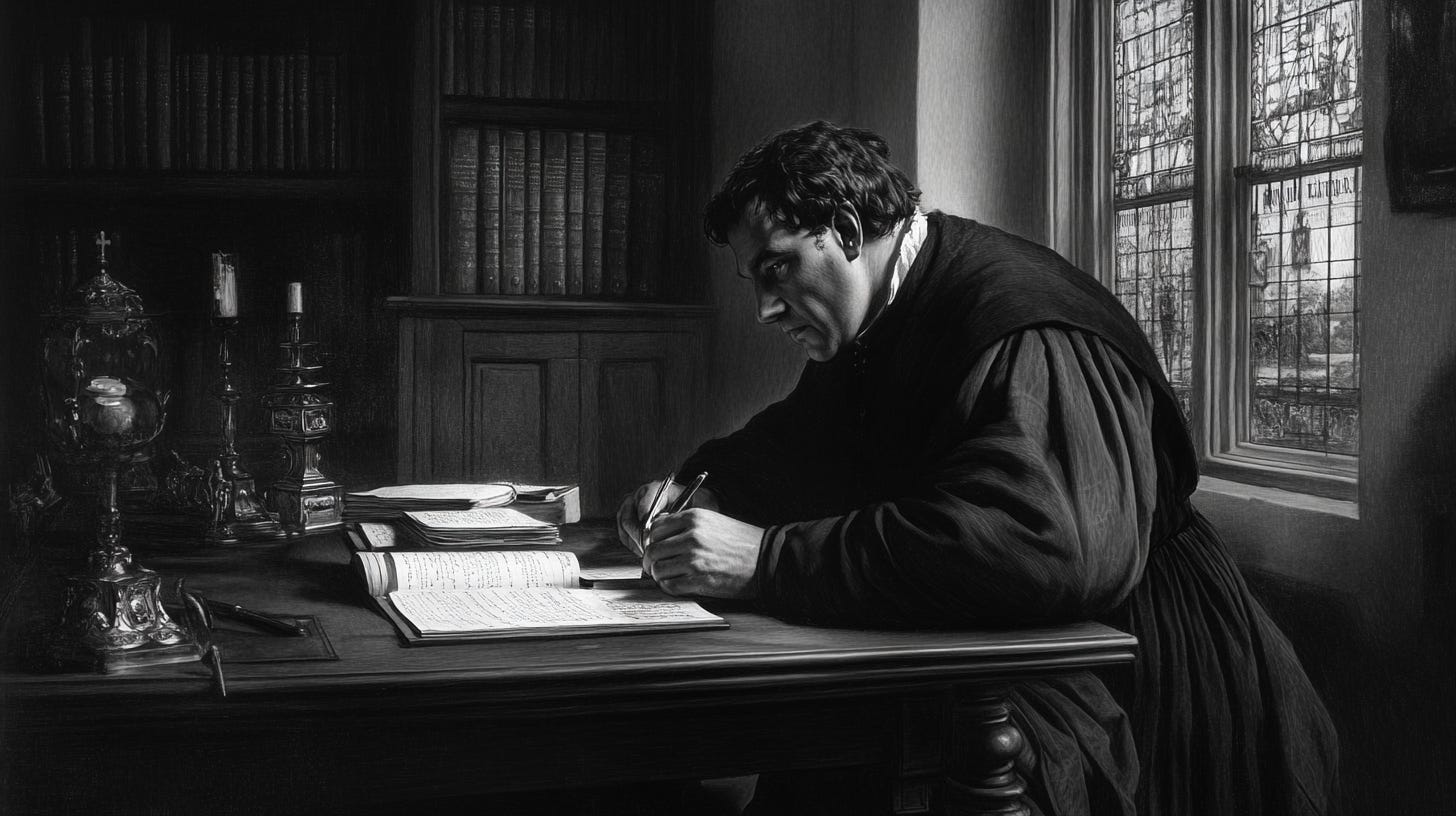
Most of what we believe about salvation today comes from Martin Luther.
He invented, and I do mean invented, several critical doctrines that would go on to change the way that Christianity was taught, like his teachings about the works of the law in Romans and Galatians, or the idea that Jesus’s teachings, such as the Sermon on the Mount, were not actually meant to be followed by Christians.
Rather, Luther argued that Jesus’s teachings were mainly meant to show us that we could not follow them, and that to try to do so too much was in itself sinful.
Luther knew very well that he was the first person to teach many of these doctrines. Biographer Richard Rex, in his book, The Making of Martin Luther, writes,
“A sense of his own theological originality stirs in this text from time to time, [as] when he remarked that, ‘What follows I have never seen explained in any of the doctors of the church. Jerome, Augustine, and Ambrose all pass over it. I have not been able to think well of any doctor. They have become of little value to me.’”
In this section, I want to talk about what Luther’s theological inventions were, how he came to believe them, and how they have affected what modern Christians believe about salvation.
I will be focusing on Luther’s teachings about the works of the law, as well as his views on the Sermon on the Mount and Jesus’ teachings in general.
In the last chapter, we saw how the early Gnostic ideas, like total depravity and the rejection of free will, came into the Church through Augustine in the fifth century.
Martin Luther was an Augustinian monk, meaning that he was devoted to the monastic order which followed the teachings of Augustine.
Luther became enthralled with three uniquely Augustinian doctrines, namely total depravity, also the idea that Romans Chapter 7 was a picture of the normal Christian life, and of course, the idea that man did not have free will. Like Augustine, Luther completely rejected the idea of free will. Luther said,
“Free will is an empty term whose reality is lost. It is a mere lie.”1
In addition to Augustine’s views on free will and total depravity, Luther also adopted Augustine’s view on Romans 7:14-25, where Augustine argued that Paul was speaking of how he, Paul, as a Christian, was still enslaved to sin, even after salvation, and that Paul was a wretched sinner, and therefore, Romans 7 is a picture of the normal Christian life.
Romans 7:15 says:
“For what I am doing, I do not understand, for I am not practicing what I would like to do, but I am doing the very thing I hate.” - Romans 7:15
The early Church, for the first 300 years or so, unanimously agreed that Paul in Romans 7 was talking about life under the law, before becoming a Christian, and that Romans 7 was intended to be contrasted with the two chapters on either side of it, that is, Romans 6 and Romans 8, where it talks about how Christians are now able to overcome the slavery of sin through the power of the Holy Spirit.
The early Church would point out, for example, that:
Paul in Romans 7:14 said he was, “a slave to the law of sin,” (7:14, 7:23-25). But in the chapter both before and after this, he says he was, “set free from the law of sin,” (6:18, 6:6-7, and 8:2).
Or how in Romans 7:25, he, “walks according to the flesh,” but in the next chapter, he, “no longer walks according to the flesh,” (8:4).
Or how in 7:25, his mind is, “set on the flesh,” but in the next chapter, his mind is, “set on the spirit and not the flesh,” (8:4-9).
Or how in chapter 7 he, “practices sin and evil that he does not want to do,” (7:15-19), but in the previous chapter, he, “no longer practices sin,” (6:1-2, 6:6-7, 6:11-13).
Without any question, Romans 7 is a different picture of the Christian life than found in Romans 6 and Romans 8. But it’s also a different picture from the Christian life found in the rest of the New Testament!
Possibly as a result of Luther adopting Augustine’s doctrines of total depravity, Romans 7 as the normal Christian life, as well as his views on works, which we’ll look at in a second, it led Luther to teaching that sinning in the Christian life was not just normal, but that sin was a kind of virtue.
For example, in his famous letter to Philipp Melanchthon, Luther tells him,
“Be a sinner, and let your sins be strong. No sin can separate us from Him, even if we were to kill or commit adultery thousands of times each day.” 2
Or in a different letter,
“Sometimes it’s necessary to drink a little more, play, jest, or even commit some sin in defiance and contempt of the devil. We shall be overcome if we worry too much about falling into some sin.”3
The early Church did not believe in sinless perfection, in fact, they argued against it, but the idea that a Christian would willfully sin would have been clear evidence to them of that person not going to heaven unless that person stopped doing that sin. And willful sinners were kicked out of the church until they repented, as the New Testament clearly teaches that they should be.
“But actually, I wrote to you not to associate with any so-called brother if he is an immoral person, or covetous, or an idolater, or a reviler, or a drunkard, or a swindler, not even to eat with such a one.” - 1 Corinthians 5:11
So we need to dig a little deeper to see how Martin Luther felt that he could overturn the Christian writer that came before him on the subject of sin and salvation. And to do that, we need to start with his unique definition of the phrase ‘works of the law.’
Redefining 'Works of the Law'
The question of what the Apostle Paul meant by the term ‘works of the law’ in the New Testament, particularly in the books of Romans and Galatians, as well as the broader term ‘works’ elsewhere, is one of the most important theological discussions in modern theology.
The debate over this term was ignited in the 1970s and has been raging in seminaries across the world ever since among scholars who recognize its critical importance.
If Martin Luther was wrong about his unique definition of the term ‘works of the law,’ then the unavoidable conclusion is that the Reformation as a whole was a catastrophic over-correction. And most evangelical Christians who think that they are going to go to heaven are in fact at great risk of falling away and going to hell.
The stakes could not be higher for what on the surface seems to be a simple word study.
Let’s begin by quoting one of the most important verses on the topic.
“Nevertheless, knowing that a man is not justified by the works of the law, but through faith in Christ Jesus, even we have believed in Christ Jesus so that we may be justified by faith in Christ and not by the works of the law, since by the works of the law, no flesh will be justified.” - Galatians 2:16
Every Christian should believe that we are justified by grace through faith and not by works, because clearly, Paul thought that this was a very important doctrine.
So we need to figure out what Paul was actually opposing here. What are these works of the law? And why is it such a big deal to know that we are not saved by them, but rather by faith?
In his PhD dissertation, which later became a published book titled, Paul’s Works of the Law in the Perspective of Second Century Reception, Doctor Matthew J. Thomas reviewed the writings of the very early church fathers, men who either knew the apostles or lived within a single generation of them, such as Iranaeus and Justin Martyr.
What Dr. Thomas found is that all of the early writers who addressed this term believed that the term ‘works of the law’ referred to Jewish rituals, things like circumcision, Sabbath-keeping, dietary laws, animal sacrifices, or other ceremonial Jewish customs.
Importantly, these writers were very careful to limit the term ‘works’ to those rituals alone. It did not include moral laws, or in the New Testament, Jesus’s commandments.
Paul and Works
Let's start by considering the historical and biblical context in which Paul wrote these strong warnings about works of the law.
In Paul’s day, as Gentiles started to join the church, many Jewish Christians insisted that the Gentile Christians should first be circumcised. In their defense, there was logic behind this, because before the new covenant, if a Gentile wanted to convert to Judaism, a process called becoming a proselyte, the Gentile in question had to become circumcised. Without that, there was no possibility of them becoming a true convert to God.
This is because in the Old Testament, circumcision was the sign of being in a covenant with God. Genesis 17:11 says:
“And you shall be circumcised in the flesh of your foreskin, and it shall be the sign of the covenant between me and you.”
Exodus 12:48 says:
“But if a stranger sojourns with you and celebrates the Passover of the Lord, let all his males be circumcised, and then let him come near to celebrate it, and he shall be like a native of the land. But no uncircumcised person may eat of it.”
So unless you were circumcised, you were not considered to be a Jew, and thus, you were not considered to be saved, because at that time, salvation was of the Jews, as Jesus said in John 4:22.
The Apostle Paul came under heavy attack from the Christian community during his first missionary journeys because he was not requiring Gentile converts to be circumcised.
And so the Christians, who were mostly former Jews at the time, couldn't see how these Gentile converts could possibly be justified if they had not first been circumcised.
As a result of this scandal, the first church council was called in Jerusalem to decide what to do about the issue. This council, sometimes called The Jerusalem Council, is detailed in the Book of Acts, chapter 15.
The Jerusalem Council ultimately decided that Gentiles did not need to be circumcised in order to become Christians. Even after this ruling, though, tensions remained. False teachers arose in large numbers, referred to as Judaizers in the New Testament, who preached the opposite of The Jerusalem Council's decision. They claimed that Gentiles did need to be circumcised to be justified, and they publicly questioned Paul’s apostleship for saying otherwise. (See Acts 21:20-26).
So the question of circumcision and if Jewish rituals in general needed to be practiced in the new covenant were incredibly important issues to Paul, as it was the main theological debate of his day, and he was at the epicenter of it all. So it was no surprise that he devoted a significant portion of his writings to that issue.
One way to demonstrate that when Paul speaks of the works of the law, he is referring to Jewish rituals like circumcision, is by looking at the passages where he talks about works in their immediate context. Take for example one of the most famous passages about the works of the law found in Romans 3:27-28, which says:
“Where then is boasting? It is excluded. By what kind of law? Of works? No, but by a law of faith. For we maintain that a man is justified by faith, apart from works of the law.” - Romans 3:27–28
Most people stop quoting this passage at verse 28, but if you read the next two verses, you can see that Paul is specifically addressing the issue of circumcision. The next line says”
“Or is God the God of the Jews only? Is he not the God of the Gentiles also? Yes, of Gentiles also, since indeed God, who will justify the circumcised by faith and the uncircumcised through faith, is one.” - Romans 3:29–30
Another very popular works passage is in Ephesians 2, where we often hear verses eight through nine quoted.
“For by grace you have been saved through faith, not a result of works, so that no-one may boast.” - Ephesians 2:8–9
But if we just keep reading two more verses, we find the specific kind of works Paul had in mind:
“Therefore remember that formerly you, a gentile in the flesh, who are called Uncircumcised by the so-called circumcision, which is performed in the flesh by human hands.” - Ephesians 2:11–13
Again, Paul is specifically talking about circumcision when making arguments about justification and works.
Martin Luther and Works
So what did Martin Luther teach about works that was so different than this? And why is it such a big deal?
Luther’s most important theological invention was the idea that the concept of works in the New Testament did not just mean rituals of the Jewish law, but rather, to Luther, the term also meant anything and everything a person could do, including repentance from sin, obedience to God or to Jesus’ commandments.
Essentially, any action whatsoever. As Doctor Thomas puts it,
“Luther holds that these words, ‘works of the law,’ are to be taken in the broadest possible sense. In short, Luther understands ‘works’ as any and all actions that one might perform.”4
Luther himself said in his preface to the Book of Romans:
“The works of the law are everything that a person does or can do of his own free will, and by his own powers, to obey the law.”
The problem is that Luther’s definition of the word ‘works’ cannot be supported from scripture.
If you do a word study of the word ‘works’ in the New Testament, you’ll find that it was used in three basic ways:
Works as in miracles, such as mighty works that Jesus performed.
Works as in good deeds, such as giving money to the poor or helping others.
Works of the law, which, as we have seen, refers to Jewish ceremonial rituals and practices, such as circumcision.
You will not find a single time in the New Testament where the word ‘works’ is used the way that Luther and most modern Christians use it, which is to refer to things like refraining from lust, resisting drunkenness, forgiving your enemies, or trying too hard to obey Jesus’ teachings, all of which Luther condemned as works.
Luther took this a step further, though. He also taught that being obedient to moral laws was not just a work, but likely a sin.
He said in his commentary on Galatians,
“Although the works of man always seem attractive and good, they are nevertheless likely to be mortal sins.” 5
This has led directly to statements like the following, which are genuine comments I’ve seen on YouTube, but they reflect the modern Christian definition of works:
“If you think you have to do things or act a certain way or try not to sin, then I have bad news for you. You are doing works to secure your salvation.”
Statements like this, which equate trying not to sin with works, are 100% Martin Luther. Though this sentiment has become the very cornerstone of modern Christian theology, that trying to resist sin too much or thinking that obeying Jesus’ commandments is required in any way is a work.
Luther and the Sermon on the Mount
A problem then arises for Luther here, because Jesus frequently taught that people did need to resist sin to go to heaven, or forgive people, or not get drunk, acts which Luther would call works.
So how did Luther resolve his teachings about works and Jesus’ teachings against sin?
The early church believed that the Sermon on the Mount and the rest of Jesus’ teachings were meant to be obeyed by every Christian. They believed that Jesus was essentially teaching fundamental Christian doctrine in the Sermon on the Mount, which was then expanded upon in the rest of the Gospels, and that obedience to His commandments, both there and elsewhere in the New Testament, was required in order to inherit eternal life.
One of Luther’s most radical teachings, something that had also never been taught by any Christian in history before him, was the claim that Jesus’ teachings, especially those in the Sermon on the Mount, were never meant to be followed by Christians.
As Jonathan Pennington puts it in his commentary:
“Luther saw the sermon with its impossibly high demands as a kind of divine goad, meant to make all people aware of their sin and poverty before God, and thereby turn to Christ in faith. Luther said, “The law in the Sermon on the Mount is given so that man, feeling his own inability to keep it, may learn to despair of himself and seek help in Christ.”6
But this goes directly against Jesus’ plain teaching in the sermon. Jesus concludes the Sermon on the Mount by saying,
“Everyone who hears these words of mine and does not do them will be like a foolish man who built his house on the sand. The rain fell, the floods came, and the winds blew and beat against that house, and it fell. And great was its fall.” - Matthew 7:26–27
In fact, the last verse in the entire Book of Matthew and the last thing that Jesus said before ascending to heaven was:
“Make disciples, by teaching them to observe all that I have commanded you.” - Matthew 28:20
Luther would allow that a truly saved Christian might occasionally do some of the things commanded by Jesus in the Sermon on the Mount, but he insisted that obedience to Jesus was not at all required to go to heaven, and often rebuked anyone who claimed otherwise.
In fact, he accused those who called for obedience to Jesus’ teachings, like the Anabaptists, of:
“Twisting Christ’s words and turning them into a new law worse than Moses.”7
Luther went a step further, arguing that Jesus’ teachings were often the opposite of what they appeared to be, especially in cases involving anger or turning the other cheek. He wrote:
“If someone were to strike a Christian prince on one cheek, he should not turn the other, but instead protect his people and punish the offender.”8
He even said that to follow Jesus’ words literally would be foolish:
“Therefore, it would not be right to teach here to turn the other cheek and to throw away the cloak after the coat, for that would be just playing the fool.”9
Jesus said anyone who hates his brother or sister is a murderer. - 1 John 3:15
But Luther said,
“The reason I hate Erasmus with all my heart is that he brings into dispute the things that ought to be our joy.”10
Luther’s Hatred
Luther was also notorious for his hatred of the Jews, which didn’t just appear in passing. It was on nearly every page in his first writings on the Psalms, and it was there in literally his last sermon before he died, which was devoted to calling for violence against Jews.
His most notorious antisemitic work was called On the Jews and Their Lies, and it’s overflowing with hatred. He said that the government should set fire to their synagogues, destroy Jewish homes. He forbids rabbis to preach, and says that if they don't stop preaching, they should be killed. He says their money should be confiscated and they should be expelled from Germany.
Adolf Hitler acknowledged Luther’s influence in his book, Mein Kampf. And Luther’s books were often cited by the Nazi Party as their justification for the persecution of the Jews.
The Peasant’s War Murders
Luther’s rhetoric also led to violence and murder in his own day. For example, during the German Peasants’ War, 1524 to 1525, Luther advised the nobles to kill rebellious peasants, who also happened to be primarily Anabaptists and disagreed with him.
He said:
“Therefore, let everyone who can, smite, slay, and stab secretly or openly, remembering that nothing can be more poisonous, hurtful, or devilish than a rebel.”
And later, after hundreds of thousands of peasants were killed, Luther claimed credit for their deaths, while also blaming God for making him say it:
“I, Martin Luther, have during the rebellion, slain all the peasants, for it was I who ordered them to be struck dead. All their blood is upon my head. But I put it all on our Lord God, for He commanded me to speak thus.”11
Modern Takes on Luther’s Sermon on the Mount View
But getting back to our main point, Luther’s radical teaching that obedience to Jesus in the Sermon on the Mount was optional at best and sinful at worst was slow to catch on. Many of Luther’s contemporaries, like John Calvin, rejected Luther’s view at first. But eventually, Luther’s interpretation of the Sermon on the Mount became the dominant view.
Today, most pastors teach Luther’s view in one form or another, whether they realize it or not. Though the various teachers often come up with their own logic for disregarding Jesus’ teachings.
For example, the extremely popular dispensational view held by figures like C.I. Scofield and John Walvoord claim, like Luther, that the Sermon on the Mount is not meant for Christians today, but the reason they say we don't need to follow His teachings is because His teachings are only meant for the future millennial kingdom. According to this view, Jesus’ teachings are good advice, but not binding commandments for the present church age.
There are about five other major interpretive frameworks that also try to explain why Jesus’ teachings in the Sermon on the Mount and elsewhere don’t need to be followed fully.
Some simply spiritualize the teachings to do away with them, but most still claim that His teachings are only meant to show us that we’re sinners and that we can’t possibly follow the law, which is more in line with Luther’s original view.
Be Perfect
A relatively new one is that the term, “Be perfect,” in Matthew 5:48 is a kind of secret code word which reverses everything that Jesus said before it.
They’ll say that we obviously can’t be perfect, so it must mean that Jesus was not intending us to obey any of His commandments, which ignores the usage of the Greek term for perfect there, teleios, which all throughout the New Testament, means to be mature or complete and is regularly the word used of how Christians should be, that is complete and mature.
But stop and consider how bizarre this is.
Most Christians cannot agree on the most basic question: Was Jesus teaching Christianity or not?
If you reject the Sermon on the Mount as not being for Christians, like most Evangelicals do in one way or another, what are you going to do with the rest of his teachings, which all seem to expand on the themes introduced in the Sermon on the Mount?
It’s not like his other teachings are different than the Sermon on the Mount. Take for example his commandment for us to forgive others or you will not be forgiven, which he first mentioned in the Sermon on the Mount.
He says the exact same thing in the Sermon on the Plain in Luke 6 and The Parable of the Unforgiving Servant in Matthew 18, and in his teachings on prayer in Mark 11:25.
So to reject the Sermon on the Mount as not Christian is to reject all of Jesus’ teachings as not Christian, which is the height of absurdity.
If Jesus didn’t preach Christianity, who did? Luther would say that Paul did, especially in the books of Romans and Galatians, the two books that contain the phrase “works of the law,” which, as we’ve seen, is what Luther’s entire system of Christianity depends on.
If you take away nothing else, take away this. Martin Luther taught us that the works that Paul was rebuking were things like repentance from sin and following Jesus’ commandments, and that Jesus wasn’t really teaching Christianity in the Sermon on the Mount, but only trying to show us that we cannot follow his commandments.
But these doctrines had never been taught before Martin Luther.
Basically, if Luther was right about salvation, it would mean that no one had ever figured out the truth about salvation until Martin Luther, that for 1,500 years after the Bible was written, not one single Christian knew how to be saved.
Either Jesus meant what he said, or Martin Luther was right and Jesus meant almost nothing of what he said.
So we need to decide for ourselves, are we going to follow Martin Luther or Jesus? Because their teachings are mutually exclusive. You cannot follow both.
Martin Luther, The Bondage of the Will, WA 18:636
Martin Luther, Letter to Philipp Melanchthon, August 1, 1521
Martin Luther, Letter to Jerome Weller, July 1530
Paul's "Works of the Law" in the Perspective of Second-Century Reception—Dr. Matthew J. Thomas
Martin Luther, Heidelberg Disputation, Thesis 3 (1518)
Jonathan T. Pennington, The Sermon on the Mount and Human Flourishing, p. 8
Martin Luther, Against the Heavenly Prophets in the Matter of Images and the Sacrament (1525), in Luther's Works, vol. 40,
Martin Luther, On Secular Authority (1523)
Martin Luther, Commentary on the Sermon on the Mount, in Luther’s Works, vol. 21
Martin Luther - WA Tr 1.494, p. 219, 25 March 1533.
Martin Luther, Table Talk (Tischreden), Erlangen Edition, Vol. 59, p. 284